Much has been written about the ‘eager to please’ nature of contemporary LLMs. This goes beyond the fine-tuned, guard-railed ‘personality’ of the model (see my experiments with LLM personality from last year) – fundamentally the LLM will endeavour to follow the prompt, no matter how absurd or seemingly nonsensical. This is distinctly un-human behaviour. We tend to call out nonsense and refuse to answer stupid questions; chatbots do the opposite.
The first person to create an LLM which can confidently answer a prompt with “I have no idea” will be very rich.
This experiment came out of day spent at the AI playgroup, investigating ‘productivity tools’. As an artist, my definition of what constitutes ‘productivity’ is perhaps different from the other attendees, and I set myself the task of creating an AI based connection machine to increase my ideation productivity.
I have a very wide range of interests, and often artistic ideas emerge from seemingly unconnected ideas bumping into each other in my mind – I wondered if I could use AI to improve my productivity in this domain.
I’ve recently been re-watching James Burke’s Connections, which I remember fondly as a child. In this programme Burke weaves his tales based around the connections between people, places and events – often these are fascinating, unexpected juxtapositions, sometimes they are somewhat arbitrary, but the pace is so delightful we can generally ignore the more tenuous links.
It is also the source of the best-timed shot in tv history:
Because LLMs are so eager-to-please, they are willing to make connections between anything – that’s what makes them so powerful, but we are often blind to some of their weirder conceptual links because they are hidden amongst the more genuine information (and their people-pleasing-personalities).
This project leans in to this feature of language models and uses AI to find (and justify) connections between highly disconnected subjects – the kind of weird and interesting things I currently jot down in my iPhone notes and forget about.
This is an attempt to use AI in weaving together disparate ideas, to see what interesting connections it can find.
For this experiment, I have taken an arbitrary list of subjects (Quantum Mechanics, Psionics, Jorge Luis Borges, Consciousness, Dolly Parton, Aphex Twin, Slime Mold, Greta Thunberg & Nicolas Cage) and permuted all the possible connections between them (using a small local model, Qwen-3.5 and also Claude Sonnet 5.5).
The process results in an explanation of how any two of the subjects are connected – often the connections it finds are best described as ‘a bit of a stretch’, but always entertaining.
Here’s one of the ways Nicolas Cage is related to Quantum Mechanics:
The name: John Cage and indeterminacy
Born Nicolas Coppola, he took “Cage” partly from Marvel’s Luke Cage and, by his own account, partly from the avant-garde composer John Cage. John Cage built music around chance operations (the I Ching, dice, silence as material), most famously in 4’33”. He was not a quantum physicist, but his idea that a work isn’t fully specified until it is realized in a particular moment and environment resembles quantum indeterminacy. So Nicolas Cage’s stage name points to a mid-century artistic counterpart of the same intellectual climate.
Overall, Claude creates more nuanced connections and is less likely to hallucinate nonsense, but, in the realm of art nonsense can be an important creative force.
After it has worked out the connections, the model is tasked with deriving a description of ‘an artwork based on these ideas’, and this is finally fed into an image generation model (Flux Krea2). This process is conceptually similar to my Machine Imagined Artworks project from over a decade ago.
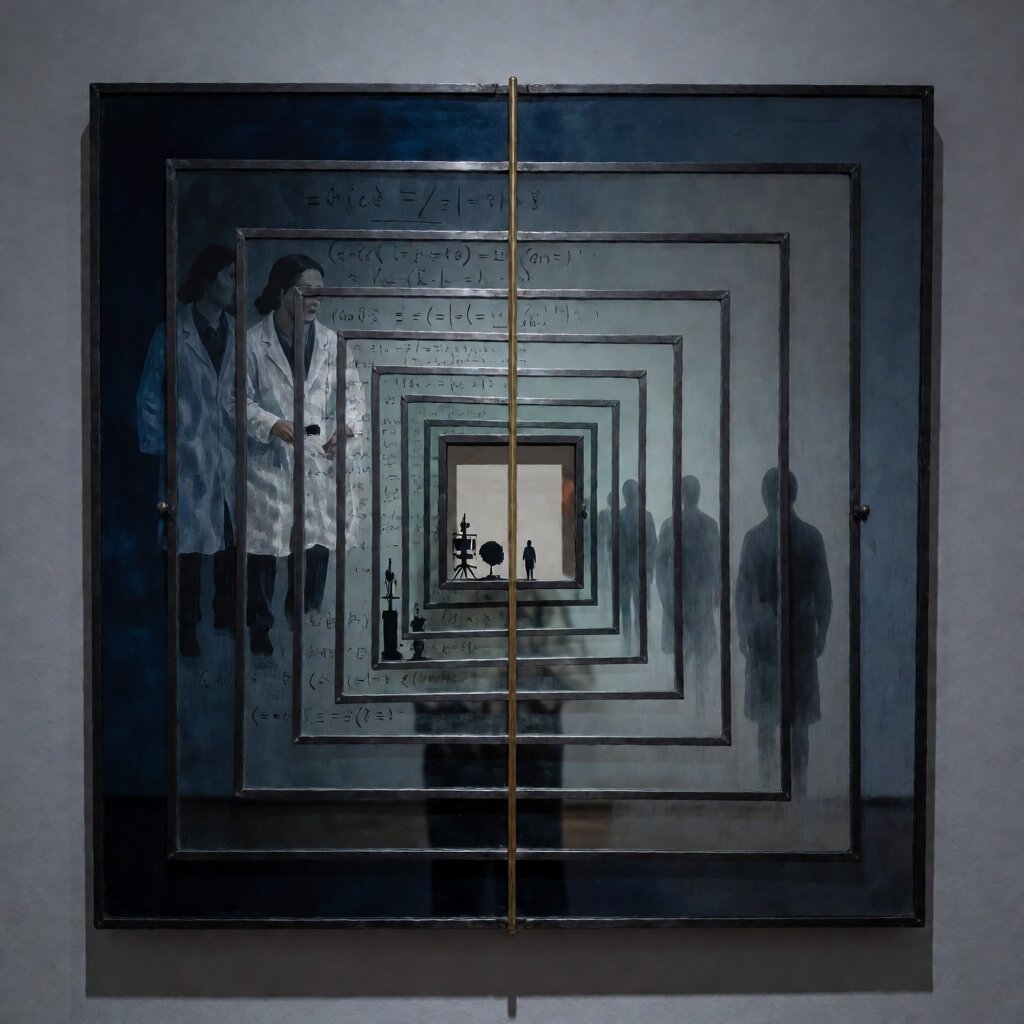
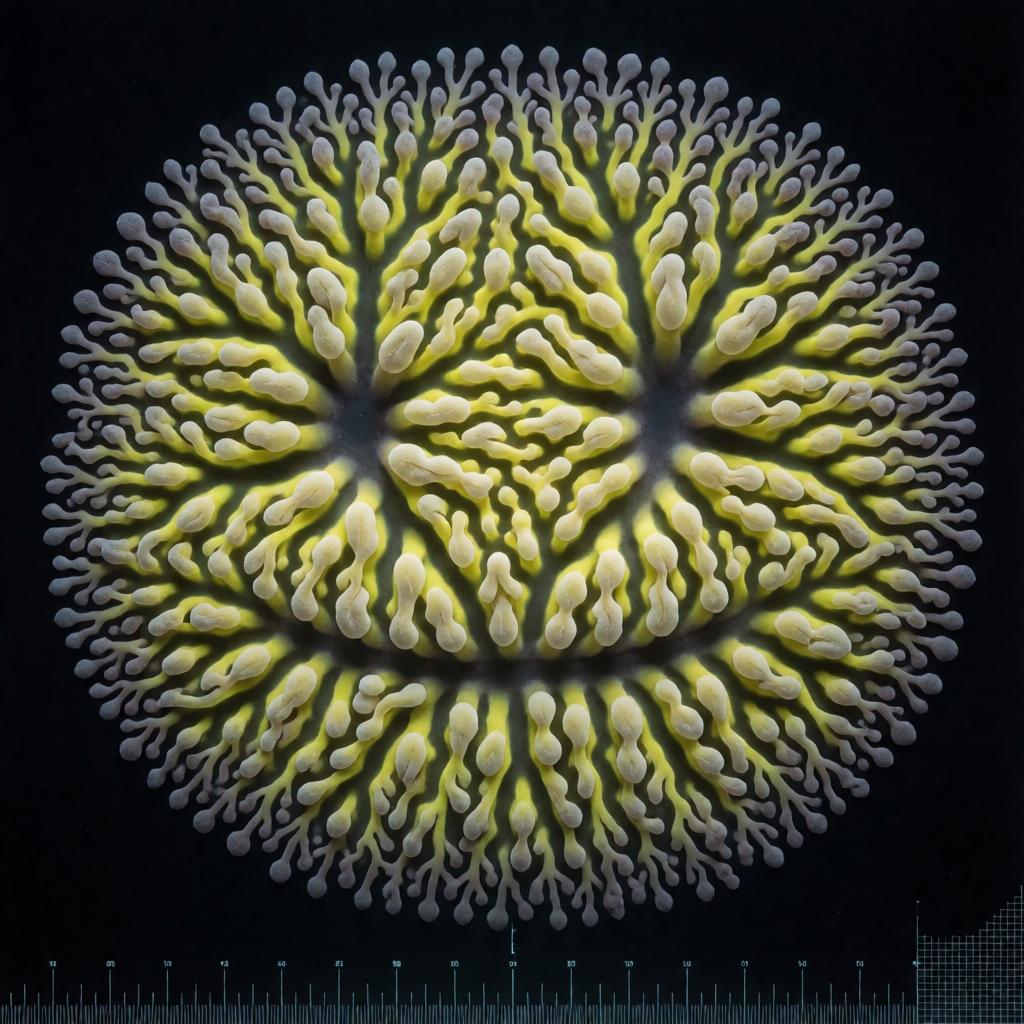
Obviously the first thing we notice is that the generated images are a bit crap, with the now very-identifiable tells of image generation. However, stepping back, some of the descriptions of the artworks are quite inspired – whilst many are far too complex and busy to actually consider making.
The Consciousness/Quantum Mechanics description is gloriously over-ambitious:
“Wall-mounted mixed-media installation: seven nested panes of hand-ground glass in blackened-steel frames, with oil and graphite on raw linen behind them, silver-leaf interference patterns, and one hidden amber LED. Roughly 3 m × 3 m, hung so the center sits at average eye level.”
Purely visually, the Aphex Twin/Slime Mold is perhaps my favourite:
Looking at how it connects things, it can take some delightful conceptual leaps. For example, this wonderfully arcane explanation of how Dolly Parton & Consciousness are related:
“Jolene as a theory-of-mind masterpiece
The song is a plea addressed to a rival, and it works by modeling another mind: her beauty, her power, her possible indifference. The narrator can’t read Jolene’s mind, so she builds one from clues. That recursive mind-reading, thinking about what someone else thinks and feels, is considered a hallmark of human-level consciousness and social cognition. The song also lets millions of listeners share one emotional state, which is a small demonstration of intersubjectivity.”
I encourage you to play around with the viewer embedded below.
Overall, most of these ideas are a bit crap, but some of them are interesting enough to lead my meat-bag brain off in new directions, perhaps resulting in a new art work. Is this “cheating”? Is this kind of AI usage acceptable in the realm of art? Personally, I wouldn’t be happy presenting the generated images as being ‘my work’ – they’re a bit rubbish and I certainly don’t feel like I exerted much creative effort.
But who knows, maybe the idea of a slime-mold timelapse has legs?..